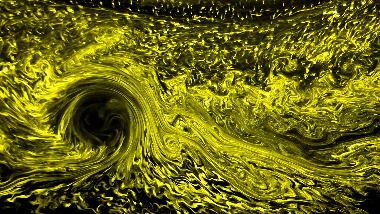

The laboratory experiment at the Coriolis Platform is motivated by previous oceanographic studies in the Levantine Basin. Field campaigns, in-situ measurements and numerical simulations revealed the presence of an anticyclonic eddy called Cyprus eddy which forms south of the island of Cyprus and could have a life also of two years. Its center varies between 32° - 42.5°E and the radius is approximately 50 km. Gliders observations conducted in 2017 by the National Institute of Oceanography and Applied Geophysics (OGS) group (Mauri et al., 2019) along with other previous studies (Zodiatis et al., 2005 ; Bosse et al., 2016) have shown that the Cyprus eddy extends from the surface up to 800 m of depth and locates above the Eratosthenes seamount whose summit depth is 700 m over a water depth of 2500 m. On the right side of the Cyprus eddy, a smaller cyclonic eddy (named South Shikmona Eddy - SSE) and an anticyclonic eddy (named North Shikmona Eddy -NSE) also appears.