

Journal of Wind Engineering and Industrial Aerodynamics - Volume 270, March 2026, 106339
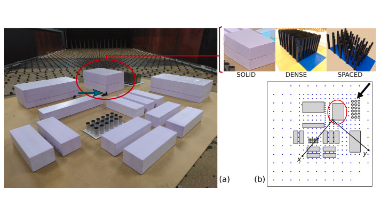
The accidental release of hazardous airborne pollutants on industrial sites creates risks associated with the exceedance of toxicity or explosivity limits. Capturing these risks requires predicting higher-order statistics of concentration fluctuations at various distances from the source. This challenge, already complex in atmospheric boundary layers, is further complicated by the typical built environment of industrial sites. To address this, we conducted wind-tunnel experiments on the dispersion of a passive scalar from a localized ground-level source within a reduced-scale model of an industrial site. The experiments measured the velocity and concentration fields, while varying the geometry of an upstream building simulating typical complex industrial structures.
A key focus of our investigation is the one-point passive scalar concentration PDF, whose experimental realizations were systematically compared to three analytical models: the gamma, two-parameter Weibull and lognormal distributions. The gamma distribution generally provides the best predictions, although the lognormal model performs better within the building wake near the source. While the main discrepancies between theoretical distributions and experimental data consistently occur at low concentration values, all three distributions accurately predict the 95th and 99th concentration percentiles. Thus, peak and hazardous concentration levels can be reliably estimated even without fully capturing the complete concentration distribution.